Berlin
The Spy Who Came in from the ColdBerlin is the novel’s decisive geography: a city cut by the Wall, where a checkpoint can turn escape into execution and where even crossing from West to East becomes part of an intelligence operation. Its ruins, borders, and clandestine networks make the political division tangible, while its streets and transit routes expose how little freedom the people moving through them truly possess.
The Divided City and Its Wall
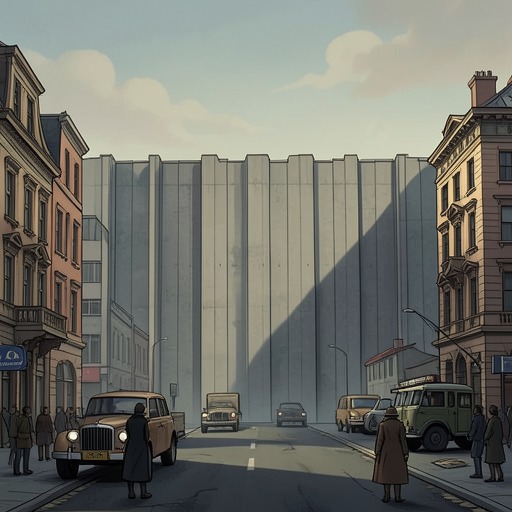
Berlin’s Wall is more than a backdrop to the novel. The narrator recalls flying from Bonn to see it as construction began, confronting guards at the new barrier and feeling disgust and terror at what he saw. The Wall functioned as theatre as well as symbol: a visible spectacle of ideology made physical. Its presence establishes Berlin as a place where political power could be seen, crossed only at risk, and enforced against individual lives.
The city’s division also gives the Cold War a specific and immediate form. At Checkpoint Charlie, American and Soviet Bloc tanks faced each other across a hundred-yard strip of road, their guns trained on the opposing turrets. Their engines roared as if the vehicles were boxers psyching each other before a fight. The Embassy discussed evacuation plans, but the prospect of escape seemed almost meaningless against the possibility that the world itself was about to end. Berlin is therefore not simply a setting for espionage: it is a pressure point where a local border can appear to hold the fate of a much larger conflict.
As the Wall was strengthened and heightened, its defenses included mined strips and earth smoothed so finely that a rabbit’s paw could be traced across it. People nevertheless climbed over, broke through, dug under, or flew across in improvised gliders. The narrator presents successful escapees as heroes precisely because so few managed it and because the attempt demanded such courage. Their individual crossings become a vanguard image for later popular liberation in East Germany, linking the city’s restrictive geography to a future beyond it.
Checkpoints, Ruins, and Escape
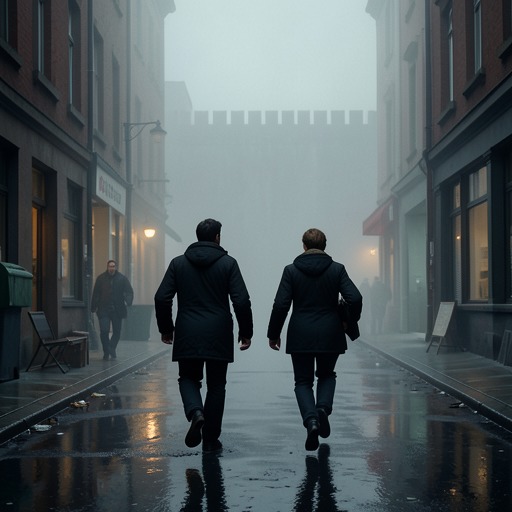
The novel’s Berlin is also a damaged landscape. At night, the Wall appears to Leamas as dirty breeze blocks and strands of barbed wire beneath cheap yellow light; on either side lies an unrestored quarter, a half-world of ruins reduced to a stark, almost two-dimensional field of war. The image refuses the reassuring distance of a political map. Berlin’s division is encountered at street level, in hostile light, battered ground, and the exposed routes between barriers.
That landscape becomes lethal during Karl Riemeck’s attempted escape. Leamas watches through binoculars as Karl, disguised in an old Wehrmacht raincoat and pushing a bicycle, passes document checks and reaches Customs. For a moment the crossing seems nearly complete: Karl waves to the barrier guard, the red-and-white pole rises, and he is coming toward the line and safety. Then searchlights seize him in their beam, a siren sounds, and East German police take up positions behind sandbagged openings. A sentry fires into his own sector. The shots drive Karl forward and then pull him back; he keeps moving on the bicycle until he sags to the ground and the bicycle clatters down. Berlin’s border turns a plausible passage into a public killing, while Leamas can only watch from the other side and hope Karl is dead.
Intelligence Networks and the City’s New Borders
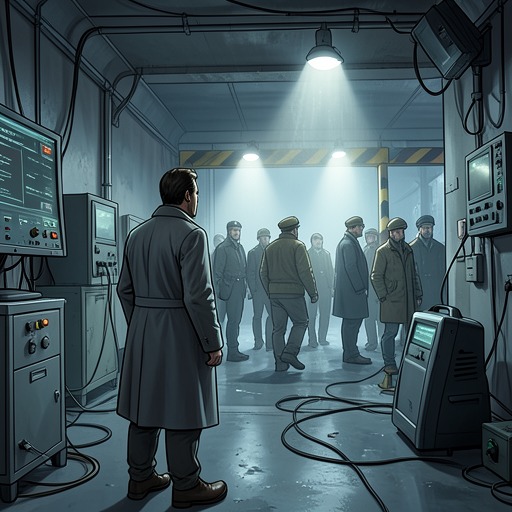
The Wall also alters the work of espionage. British, American, French, and West German agents had been caught unprepared by its construction; none, to the narrator’s knowledge, had forecast it. Some would become stay-behind agents, communicating by hidden radios and prearranged forms of secret writing. The new border made intelligence work more clandestine, more perilous, and more crowded, while changing the practical conditions in which agents could communicate and move. Berlin’s political geography thus becomes part of the machinery of the plot: the city’s divisions reshape the networks that operate within and around it.
The city’s routes continue to structure the action after Leamas leaves it. At Tempelhof, arriving near dusk with Peters, he watches the lights of Berlin rise and passes through the airport’s corridors and cursory Customs and immigration check. He fears that an old acquaintance might recognize him, then realizes that the fear conceals a hope that circumstance might revoke his decision to continue. Peters treats West Berlin as safe ground, a temporary staging post where vigilance can relax. The airport is a threshold between the familiar life Leamas has left and the operation carrying him east.
The crossing itself is startlingly easy. After a period of waiting, a DKW overtakes the Mercedes carrying Leamas and stops at the West German police hut. When the barrier lifts for it, both cars drive through the checkpoint and across the fifty yards between the two posts. Leamas notices the eastern fortifications—dragon’s teeth, observation towers, and double aprons of barbed wire—before the Mercedes passes the second checkpoint without stopping, its barriers already raised and the East German police watching through binoculars. The convoy continues east through the city instead of pausing to change cars or celebrate. The contrast with Karl’s exposed, fatal crossing makes Leamas’s passage look less like freedom than controlled transit.
Berlin as a Measure of Leamas’s Defeat
Berlin is bound to Leamas’s professional identity as well as his physical movements. Looking down at the Tempelhof runway as his plane departs, he understands that he has been written off. For years he had stayed in Berlin rather than accept a desk job at the Circus, persisting in operational work because he still got results. That measure of professional worth collapses when Mundt defeats him. The city that had been the arena of his work becomes the place from which he leaves, with his sense of agency diminished along with his standing.
Even after Leamas’s defection, Berlin’s intelligence history governs what he can tell his captors and what they believe. Peters questions whether Karl could have supplied so much material alone; Leamas recognizes that Control had raised the same issue about Karl’s access. Their agreement suggests a high-level collaborator behind the intelligence, though Leamas can only speculate about the identity and the protection surrounding that person. Berlin’s hidden network is therefore not exhausted by the information Leamas gives up: its gaps and unanswered questions are themselves clues.
The operation’s later investigation returns repeatedly to Berlin’s former station and its records. Fiedler explains that the intelligence Leamas has disclosed about Karl and the Berlin organization is not enough to account for the price offered for Rolling Stone. At the Tribunal, he reviews the restricted circulation of the file and the correspondence with banks in Copenhagen and Helsinki, linking Leamas’s deposits to Mundt’s clandestine journeys. The questions raised by Berlin’s intelligence apparatus thus reach beyond the city, but their stakes remain tied to the people and structures built there. When Leamas suddenly understands the deception, the revelation confirms how thoroughly the operation has made his professional knowledge—and his former Berlin command—part of a trap.
Narrative Significance
Berlin’s changing borders organize the novel through contrasts: Karl’s desperate bicycle crossing and Leamas’s escorted passage; the armed standoff at Checkpoint Charlie and the apparently routine airport and checkpoint procedures; an exposed agent’s last attempt at escape and an operation whose movements are quietly prearranged. The city’s barriers do not simply prevent movement. They make movement legible to rival services, and allow apparent passage to become another instrument of control.
The narrator’s retrospective account also places the novel against the Wall’s longer history. Although the barrier was strengthened and escape remained dangerous, the courage of the few who got across is presented as continuous with the eventual liberation of the many. That hindsight sharpens the novel rather than softening it: the Wall’s political symbolism may have been clear, but its immediate human reality was terror, surveillance, and the possibility that a man on a bicycle could be shot within sight of safety. Berlin holds those scales together—the emblematic division of East and West and the particular life caught in its machinery.